Four years ago – when Russia was hit with the most severe Western sanctions ever put on a major economy, following its invasion of Ukraine – Western analysts, politicians and media pundits confidently predicted that Russia’s economy would collapse in a matter of weeks. As a result, we were assured, President Putin would be driven from power and replaced by someone more to our liking, and – importantly – Russia would no longer have the financial means to continue the war. “The Russian economy” – then the world’s 11th largest – “is on track to be cut in half,” wrote President Joe Biden in March 2022; “soon, it will not even rank among the top 20.”
As it happened, not only did the Russian economy not collapse, it surged – in mid-2023 overtaking several countries, including Germany, to become the fifth largest economy in the world. And all this while European economies – now deprived of their steady flow of cheap Russian energy – were increasingly struggling to cope. Nevertheless, we were repeatedly assured that the next round of sanctions would finally do the trick and bring Russia to its knees.
We are now on the 20th round of Western sanctions. Russia has put its economy squarely on a war footing, and – according to NATO Secretary General Mark Rutte in a July 2025 interview – is “producing three times as much ammunition in three months as the whole of NATO is doing in a year.” President Putin – whose January 2026 approval rating stands at 84% according to Statista – is as popular as ever. And although Russian leaders themselves admit the sanctions have hurt, and inflation has been a real problem – the Central Bank has had to take radical steps to keep things afloat – and although the economy has taken a downturn over the past year, analysts at the IMF and elsewhere believe the long-term economic outlook for Russia is relatively stable. How has this been possible? Why have the most brutal, draconian Western sanctions ever imposed on a major world economy essentially failed to achieve their purpose?
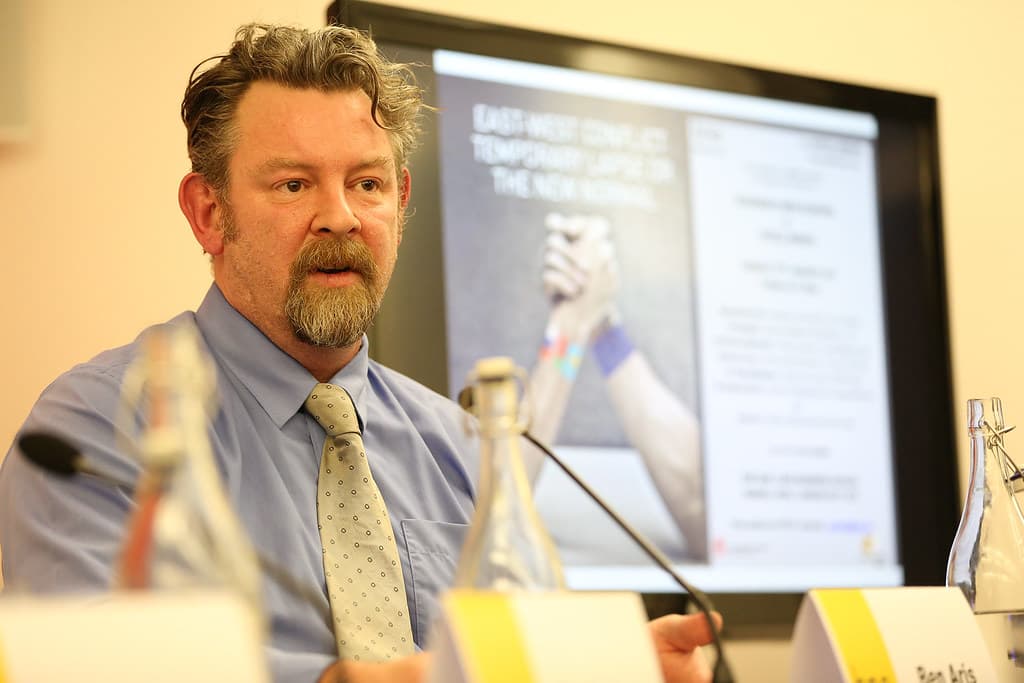
In order to gain a better understanding of just how Russia has managed to navigate these sanctions and what the country’s economic prospects are for the future, I spoke with British journalist Ben Aris, a financial correspondent with decades of experience reporting on Russia, Central and Eastern Europe, and elsewhere. In 1993 he began his first 10-year stint in Russia and Central Asia – first as a freelancer for the Economist Group’s Intelligence Unit (EIU), later as the Russian correspondent for its Business Central Europe, and finally as the Moscow bureau chief of the Daily Telegraph. In 2006 in Berlin he founded Intellinews.com, where he still serves at editor-in-chief – an international team of finance and political correspondents that report on more than 100 countries, with editorial bureaus throughout Eastern Europe, Central Asia, Africa and the Middle East. Since 2008 he has spent many years living and working in Russia, Ukraine, Estonia and elsewhere, before settling back in Berlin. He has written for the Financial Times and Newsweek, among others, and spent a decade as contributing editor at Euromoney and The Banker.
When I recently had the chance to speak with Ben, in addition to my many questions about the Russian economy, I also asked him about Ukraine’s economic situation and its outlook for the future – including its ability to finance the war should it continue much longer. Lastly, we also talked about Ukraine’s prospects for recovery – economic as well as demographic, both now in crisis – once the fighting has finally ended.
After four years of severe Western sanctions, how has the Russian economy managed to survive as well as it has, and for as long as it has?
So, let’s do a rapid, potted history of sanctions. When the war started, what shocked people – and I think what the Kremlin underestimated – was how determined and unified the European Union’s reaction to the war was. They hit them with the most extreme sanctions ever. But because Putin knew this was a possibility, he had actually been preparing the economy – sanction-proofing the economy – for nearly a decade ahead of this war. And what that involved specifically was, firstly, building up $600 billion worth of cash reserves. Now if you’re an economist, $600 billion is like two- or three-years worth of import cover – enough to pay for imports for two or three years. Typically, countries only hold three months worth of import cover. So, this was an enormous cash pile.
The second thing he did was to pay down debts – so that by the start of the war, Russia’s national debt was about 14-15% of GDP. This is an insanely low level. You know, typically in Europe, everybody is at around 90%, 100%. The US is at 120%. And why that sanction-proofs you is this: if you don’t hold debt – if you don’t need debt to fund your economy – then it can’t be cut off. If you cut off a country that needs to fund itself by borrowing, then cutting off its debt is going to cause its collapse. If Russia has no debt, you can’t sanction it like this. And moreover, the low debt it does have – 15% of GDP – Russia can cover every single dollar of this debt with cash. It can pay off its entire debt – tomorrow – with cash.
Are there any other countries in the world in a position to do that? Or is this completely unique?
There’s no other major economy in the world that can do that. And Russia did various other prudent things. They built up a Rainy Day Fund, an international welfare fund, in which there was enough money to cover the budget deficit for three or four years. And the West made mistakes. The big mistake they made was that in the first year, the sanctions did not include oil and gas. They did, as I say, introduce other extreme sanctions, including sanctions that Russia was not expecting. The freezing of the central bank’s $300 billion – that came out of left field. No one had talked about that as a possibility, in the run up to the war. That completely blindsided Russia and was a shock, because that was half of its reserves.
The second thing they did was the “nuclear option” that was discussed in the run up to the war – but no one thought they would go there. And the Germans said specifically: It’s not going to happen. And that was to exclude Russia from the SWIFT money transfer system. And that was a shock. And what that does, in effect, is to make it impossible for Russia to use dollars. And given that it’s an oil exporting country, that’s a major blow. However, Russia rebounded the first month after the sanctions were introduced.
I can remember people saying in those early days that Russia would collapse any time now.
It did come very close to collapsing. But another mistake the West made was to underestimate the quality of the finance and economics team running Russia. [Anton] Siluanov the Finance Minister, [Elvira] Nabiullina the Central Bank Governor, [Alexei] Kudrin the architect of the reforms. These are world class people – and they dealt with it. Nabiullina introduced capital controls – she seized all the dollars and started rationing them out. She didn’t lose your money – it’s just that you couldn’t get it. She introduced exchange rate controls. I mean, extreme stuff. And she hiked interest rates, because the Rouble just collapsed. She hiked the rates by ten percent. In the central banking world, it’s normally a quarter of a percent. So this was extreme. And within months, she stabilized the currency. She got control of the reserves, so that if you needed money for exports or something, you could get it.
And that was a surprise, because everyone really did think that Russia would immediately collapse – and it didn’t. And as I was saying, the really big mistake the West made in the first year was they continued to buy Russian oil and gas, which drives the German economy in particular – in other words, the whole European economy. And they weren’t prepared to sanction that. They weren’t prepared to cut themselves off from their fuel.
I remember hearing that the Russian economy actually improved quite a bit in that first year.
In the first year, rather than bankrupting the country, Russia earned a $225 billion current account surplus. This was an all-time high. It was twice as high as the previous all-time high, which was set in 2021, which was only $120 billion. And this happened because all the oil and gas prices spiked. They went up three-fold. And we in the West paid what the market demanded. So, Russia made more money in 2022 than it’s ever done in its entire existence. So that was a shock. That didn’t work. It basically meant the sanctions failed. They did cause Russia all sorts of problems, which was happily written about in the Western press. But in terms of raw macro impact on the economy, they just added to the money.
And then the whole sanctions-dodging regime began. So, Europe wasn’t importing Russian fertilisers: what happened instead, is it got sent to Abu Dhabi and then sold to an Arab, and then the Arab sold it to Europe. Same thing happened with oil: Russia sent it to Gujarat where there’s a big refinery, and they refined it into petrol – so now it’s Indian petrol, and ends up in Europe again. The only difference is, that before it took one week to sail from Primorsk down to Rotterdam, and now it takes four months to sail it to Gujarat, refine it and send it back to Europe. So, you buy the same petrol, but the costs have gone up. And as that system was put in place – all these dodges and workarounds – in 2023 Russia boomed again, and in 2024 again.
And this was mainly because of the rise in oil prices?
Not only that. Like I said, Putin was preparing for the possibility of this war for a decade, piling up cash and getting out of debt. The result of that was that he didn’t spend any money, he didn’t invest in infrastructure. What Russia was doing for the previous decade, in effect, was running an austerity regime, and gathering all this money instead of spending it on infrastructure – high speed trains, schools, hospitals – which it should have been doing. But once the war started, the Kremlin just opened the spigot – and there was a torrent of money going into the domestic economy.
And a lot of that was in order to transform civilian production into military, or at least dual-use. Suddenly factories were running in the hinterland. One of the weird effects of the war has been that a lot of the money was spent in Russia’s hinterland, in the poorest regions. Because in the Soviet era, that’s where you built all the defence sector factories, because they’re far away from Western missiles. So suddenly you had the bottom strata of Russia’s economy being employed 24-7, three shifts a day. Wages doubled, or tripled. You drew off a million men to go and fight in the war, which creates a labour shortage, which pushed up nominal wages at home. Suddenly everybody who was left at home was earning good money, and had plenty of work. There was no unemployment. And the economy boomed, because then people went out and bought houses, and people who lived in villages moved into the regional city and bought an apartment, bought a car. The wages coming back from those who joined the military were two to three times normal. And on top of that, as the military recruitment drive went on, they were paying bonuses on the order of five years worth of salary – a one-off payment, just for signing up. That money goes back to your family. So all of this drove this huge boom. And in 2023, 2024, Russia ended up being the fastest growing developed economy in the world. So rather than collapsing, it boomed.
But this hasn’t continued, has it? Isn’t the Russian economy struggling these days?
Where it changed is last year, 2025. This military “Keynesian” stimulus has worn off. The factories are now at full capacity. You’re still pumping money into the economy, but you can’t absorb it anymore. There are no more people to employ, and you can’t increase the number of weapons or whatever it is you’re producing. So, the result obviously was inflation. And this inflation has become a real problem. In 2025 it got up to 10%. So Nabiullina at the Central Bank was hiking interest rates – repeatedly. Those got up to a crushing 21% - which in central bank terms is horrifyingly high. And it has affected the economy.
So, in 2025, the growth has collapsed. Those boom years are over. And now the economics team are trying to wrestle it down. And they’re doing unorthodox, extreme things. They can’t stop the Kremlin spending money on the war – so money is being pumped into the economy. So, what Nabiullina has done is she’s artificially slowed the economic growth, crushed all credit that she could, making everything go slower in order to bring down inflation. And it’s worked – inflation has dropped, from 10% to about 5.5%.
But doesn’t this kind of economic manipulation always involve some sort of trade-off – some negative impact somewhere else?
Yes, and she’s brought down inflation at the cost of dropping growth to nearly zero. The way I describe it is this: Imagine you’re the central bank governor. You’re flying a plane, and you’re coming in to land. You want to land your plane – the economy – softly. The trouble is, the throttle is stuck on full. How do you slow down the plane when you get to the ground? So, what she has done, is she’s landing the plane without putting the landing gear down. And that will work – but it’s going to do a massive amount of damage to the plane, and you might crash and end up in a wreck. Or, if you’re lucky, you can just skid it on the grass and come to a stop. And that’s where we are at the moment.
And so, all this stuff you read now in the press – everybody’s looking at the attempt to land the plane with no landing gear, and they assume it’s going to wreck. But actually, so far, she’s got it on the ground, and it is slowing down. Yes, the damage is there – which everyone gleefully reports about. But nevertheless – is there going to be a banking crisis? No, there’s not. Is there going to be a recession? Possibly, but a very mild one.
What about Russia’s budget deficit that we sometimes hear about? Hasn’t that become a problem?
Yes, the budget deficit blew out really badly last year – it was supposed to be half a percent of GDP, and it ended up being 2.6 percent – and they thought it would be over three. Three percent is an important number for budget deficits, because that’s the EU’s excessive debt limit. If you’re in the EU and you get a deficit over three percent of GDP, then the EU punishes you. But if we put it in historical context, they’ve done an amazing job.
I looked this up, I was curious: What was the American deficit when it went into the Second World War? They did the same thing, a massive Keynesian spend on military equipment, to send to the allies. In the first year of the war, America’s deficit was 14%. Russia’s worst result so far has been 2.6%. In the second and third years, the US deficit was 22% to 25% of GDP. A quarter of the country’s value was the budget deficit. And Russia is likely to reduce the deficit this year, or it might go up to be maybe three percent. So if you put it into the historical context of what went on in the Second World War, it’s nothing. It’s absolutely nothing.
You’ve often praised Elvira Nabiullina in your column, and it does seem bordering on the miraculous what she’s done with the economy. How do you account for that? Is she a genius or has she been lucky?
She’s a veteran. Look, the cleverest Russians are really clever. And one of the bits of capitalism they’re really good at is finance. Because they’ve got their hard maths degrees, their MSU PhDs behind them. There’s this team I keep talking about, and they all trained under Kudrin. Nabiullina, the Central Bank Governor, is one of them. And she’s proven herself to be exceptionally good. But she comes out of this stable of very high-quality people who all know each other, have been working together, and they’re steeped in the research. All of the top analysts at the investment banks have come out of the macroeconomic research department at the Central Bank of Russia.
Most of the top analysts I know have worked there at some point. And there’s this revolving door of information. When I was working for The Banker in the ’noughties, we had Kudrin on the front cover as the best finance minister in the world. They’re all just astoundingly good at their job. And everyone underestimated that. And as I say – in the first month, watching Nabiullina go into action, she just didn’t mess around. She knew exactly what was coming. She knew exactly what she was going to do. And everyone looked at that. And the Russians in finance, in big business, they’re saying: Thank God for her. She knows what she’s doing, and we’ll be all right. If she tells us to do something, we’ll do it.
I remember you writing about one episode, where there was a crucial economic situation because of the war, and she or her team went to the big commercial companies and said: We need you to lose money for six months in order for Russia to get past this crisis. And they agreed.
Yes, there is this two-way street. And they do that regularly – it’s not the first time this has happened. So they’re dealing with inflation, and they go to the supermarkets, the big ones, and they say: Look, guys, do us a favour. Take one for the motherland. Don’t increase the price of bread for six months. Now the oligarchs – at the end of the day they’re all profit-driven. They’re proper capitalists in the same way as in the West. But they’ll say: All right, we get where you’re coming from. We understand why you want this – you need to bring down inflation, or control it. And this is going to cut into our profits, or we’ll have no profits at all, for six months. We’ll do it – but only for six months. And the Central Bank and the government team take that. Everyone accepts it, because the alternative – and we’ve seen this in the other former Soviet states – the alternative is to reintroduce Soviet-era price controls. And everybody knows where that ends up. And no one wants to go there.
I just can’t imagine this sort of thing happening in the United States.
It makes a difference, it buys time. But it also helps by bringing down the inflationary expectations of the population. If there’s been a disaster, and bread prices haven’t moved – then the population is thinking: Okay, we’re reading about all this stuff in the press, but bread is still 200 roubles a loaf – so it’s not so bad. And everyone pitches in a little bit.
Let’s talk about the current situation. You mentioned a recession, and some people are saying Russia is already in one. What is the economic outlook if this war goes on for much longer? And if Western governments continue trying to crash the Russian economy?
Well, let’s deal with the easy one first – Western governments trying to crash the economy. As far as I’m concerned, they’re all deluding themselves that they can crash the Russian economy. Because if you listen to the rhetoric – and I’m talking specifically here from Europe – the mantra is: We just need to tighten the sanctions a little bit more and enforce them a little bit stricter, and then the Russian economy will collapse and Putin will run out of money. We’re now on the 20th sanction package. As far as I’m concerned, they ceased to have any real impact after the fifth one. And this new one they’re talking about now is about going after the “Shadow Fleet” and “strangling” it. And it’s nonsense.
Because first of all, 20% of the Shadow Fleet are actually EU-licensed, regulated Greek ships that are doing this business legally – because Russia is paying really fat margins to carry. So you’ve got EU-registered Greek ships carrying Russian oil to Gujarat and back, and making a fortune out of it. This Gujarat backdoor is ignored by the EU, because if it really did cut itself off, there would be no petrol. Secondly, you remember the “price cap” they introduced in 2022? You couldn’t carry Russian oil if it was priced above $60 a barrel. And not a single cargo was refused. Not a single one. They just rewrote the contracts for $59, or they moved the costs. They just said: Right, we’re going to do it for $59, and when you get to the other end, we’re going to give you a “surcharge” of the navigation costs and steerage, etc. – which happens to be $35. It was a joke. And throughout the entire sanction regime, every one that’s been introduced has been riddled through with carve-outs and exceptions.
Wasn’t Russia forced to redirect a lot of its oil to China and India because of the sanctions?
When Europe finally did fully ban the import of both crude and oil products at the end of 2022, it took Russia four months to reorganize the entire export from Europe to Asia. This is one of the biggest, most sophisticated – something like $4 trillion – commodity markets in the world. And for Russia to be able to take 70 years’ worth of that business and turn the whole thing on a penny and send it all to Asia in the space of four months, is stunning. But it highlights the point I was making earlier about how quickly and effectively Russia has been able to reorganize its markets to take account of these sanctions.
I’ll give you another example. Trump has imposed practically no sanctions, but he did impose one, where he hit Lukoil, one of the two biggest oil companies. And when the sanctions came in, everybody cut trading ties with Lukoil. So its exports dropped by a million barrels a day, which is significant. But if you look at the statistics for all the non-sanctioned state-associated oil companies who are trading, their exports went up by a million barrels a day. So it’s a shell game. Typically, when they put a new sanction in, it takes three months for everyone to work out the new scheme. And these schemes are endless. And China participates, the UAE participates, Turkey participates, Belarus participates. Germany is on board with the sanctions, but it refused to stamp on the German car manufacturers who are exporting to Kyrgyzstan and Belarus, knowing full well those cars are ending up on the streets of Moscow. Because the car industry is in collapse. Volkswagen has closed its first two plants in its history in Germany, because it’s not making any money. So they can’t do it – and everyone is quietly ignoring this.
But would it impact Russia much at this point if Europe really did cut itself off completely from Russian oil?
Well, we talked a lot about oil, but actually oil is not the biggest earner for the Russian budget. It used to make up 40 or 50% in the Yeltsin days, and under Putin it was still 30 or 40%. However, under Putin it’s dropped to 25%. The biggest earner for the Russian state budget today is VAT – the sale of goods in the kiosks, in the supermarkets. And that’s an internal thing – you can’t touch it. 40% of the Kremlin’s income is VAT. Oil makes up only 25%. And the Ministry of Finance is preparing for it to go down further, to something like 15 or 20%.
So they know it’s falling, and they’re OK with that – they’re making their money from VAT. And so the irony of all these sanctions, is that it’s forced deep root and branch reforms and efficiencies in the tax service – reforms that were being continually put off, because you had this torrent of free oil money. So nobody could be bothered to worry about whether people are paying their VAT properly – because we’ve got so much money from oil, it doesn’t matter. And now it does matter. The standout statistic for me is this: in the last three years, the tax burden has been increased by 2% – the tax take has gone up by 20%.
And how did they manage that?
It’s Mishustin. Mikhail Mishustin is now Prime Minister. He’s a former investment banker from this circle of clever people I was talking about. He was made head of tax, and he introduced a new IT system which is state of the art. I talk to people doing tech projects. You can now go into a supermarket, you can buy a bottle of Coca-Cola and they put it through the cash register. And you can immediately log into your page – your account at the Ministry of Finance – and see the tax payment that was taken, the VAT that was sent to the state budget from the purchase you made 30 seconds ago. And Coca-Cola got really excited about this, because suddenly Coke knows exactly who its customers are. And so they’re doing things like cashback – and it’s radical. It’s leading the world in technology – the sophistication and depth of it.
And it’s not just tax – they’ve united all of the government services under a thing called Gosuslugi, which means government services. Everything is going in there. You can register your kids at school, you can get a new passport, you can look at your tax returns, you can see what taxes you paid and where they’ve gone in the budget. And whether the store is cheating you – is it actually recording your sales? It’s mind blowing. And it’s not just Russia – China is doing the same thing. Estonia is well ahead. The Uzbeks are doing the same thing. They’re leaving the West behind in this.
And in Russia, is this technology that we’re talking about home-grown, or are they getting it from China or somewhere else?
No, it’s home-grown. Again, Russian technology is founded on their own hard science education.
Let’s go back to the other part of my earlier question – Russia’s ability to continue funding the war if it goes on much longer. How do you see that?
Well, I’ve been praising the economic team, but the reality is that the economy is hurting. True, the sanctions will not bankrupt the Kremlin – it doesn’t rely heavily enough on oil. But they do reduce that income, and that’s a major inconvenience. Nonetheless, for two years Putin can ignore the economy because he has cash in the bank, which means military spending can continue as it is. It’s already elevated at massive levels, to the point where Russia is outproducing not only Ukraine, but all of Europe and Ukraine combined, in terms of weapons and ammo.
And to put it into larger perspective: there’s something like six trillion roubles in the Rainy Day Fund, but they also have a second store of cash – which is the liquidity in the banking sector. And there, they have something like 20 trillion roubles. That’s enough for seven years of war. And the way you tap into that is to issue domestic bonds – borrowing from banks – which is what they’ve been doing. Basically you’re tapping the money in the deposit savings. But the downside with this is that it’s limited, because the cost of that borrowing is now obviously very high, given the interest rates. The banking sector is booming and making huge profits, but the cost of borrowing is starting to be painful.
There is, however, one more thing they can do – which they haven’t done or are just starting to do – and that is to raise taxes. Russia still has some of the lowest taxes in Europe. The income tax is 13%. Corporate taxes are something like 20-25%. Some of the lowest in Europe. They did raise VAT just recently by another two points, so it’s now at 22% - which is typical by European standards. That’s not punishing at all. So they’ve got loads of headroom.
Getting back to oil for a moment – has India reduced its purchases of Russian oil much since the US started pressuring them? And how much of an impact has it had?
So the first thing to say is that the private Indian refineries have reduced imports – because they’re afraid of being hit with secondary sanctions. But the government refineries, as far as I know, haven’t reduced. It’s a point of principle for Modi not to be bullied, because he’s talking about “our sovereign independence”, and his argument is that it’s India’s national interest to buy Russian oil – especially because there is now a $20 discount on the international price. Current prices are between $60 and $70 a barrel. Take away $20 from that – that’s a third off. If you can buy the basic energy commodity at a 30% discount, you’re going to do it. You’d be stupid not to.
As for the impact on Russia – the volume of oil that has been reduced in India has been entirely taken up by China. And the Chinese can’t be sanctioned by the US, because they’ll just cut them off from raw minerals – so they’re immune to sanctions and threats. And the Chinese are just buying up the oil, and for the same reason – the $20 discount. They’ve started to build up their strategic oil reserves, and they’re just pouring the oil in there.
Let’s move on to Ukraine, where it seems the economic situation is much worse. What is Ukraine’s financial outlook – whether the war ends soon, or if it doesn’t end soon? What kind of shape are they in?
They’re in horrible shape. And again – if you read all the op-eds and opinions here in the West, you’ll be well aware that Russia’s economy is being battered and is not looking particularly healthy – but nobody writes about the state of the Ukrainian economy. We did a side-by-side comparison of the two – and all of the problems that Russia has, are just multiple times worse in Ukraine.
Ukraine is spending, I forget, something like 60% of GDP on defence. Russia is spending 8%. The budget deficit in Ukraine is something like $50 billion – which is 50%, half the economy. Russia’s is still under 3%.
And Trump has cut off all US money to Ukraine since January 2025. That has all been shifted to Europe, and Europe is really struggling to come up with the money. They wanted to seize Russia’s reserve assets kept in the EU – the $300 billion that got frozen – but they couldn’t do that because it’s illegal under the EU’s own laws. So instead, they’ve gone for a 90 billion euro loan over two years, which will be raised by the EU issuing a very rare collective European bond – the “EU Bond”, which is backed by the European budget. That’s only 60% of the 150 billion euros Ukraine needs over two years to keep going. The rest of the missing money can be scraped together from other sources. But two-thirds of all that money will go on military – so it’ll just be blown up. One-third will go on funding the budget. So Zelensky has been given two years, in which he can continue fighting if he chooses to – if the talks fail. But the economy is slowing. The exchange rate is relatively solid at the moment, but they have a chronic lack of men, which is getting worse.
And don’t they have a serious shortage of military equipment?
The military supply situation has improved because Ukraine has done a heroic job of investing into its own domestic productions. So on the drone front, they’re holding their own with Russia. And the drones are key, because the drones won’t win you the war – but they will prevent Russia from winning. For example, the Russians recently took Pokrovsk, a key city, but they haven’t been able to consolidate it, because despite the fact the Ukrainian forces largely withdrew, if a Russian soldier steps outside of his house and walks down the street, he will be killed by a Ukrainian drone. And there’s no getting away from it. It’s a problem for both sides. So with drones it’s a kind of stalemate.
But the big disparity is in missiles. Ukraine doesn’t have missiles, and it’s only being supplied with a few. And most importantly, it doesn’t have ammo for its Patriot missile defence system. It has virtually run out. And without those, the skies are open to Russian missiles. So Russia flies in swarms of drones, hundreds of them, on a key target, then more swarms half an hour later, and then again later, in order to exhaust what limited air defence ammo that Ukraine has. Then they hit it with four or five really powerful missiles that just flatten everything. They can do this because they’re now producing seven million drones a year. And consequently, almost all of the power sector has now been blown up. So how do you rebuild a country that’s got no power stations? I mean, the nuclear ones are not being touched, for obvious reasons. So you’ve got some significant amount of power from them. But your economy’s going to be on crutches dealing with that. And that’s the tactic – Putin is just wearing it down.
But there’s only so much Ukraine can take. Isn’t it possible they could reach a kind of “point of no return”?
I’ve just been talking to some people in Kiev today, and they were actually raising the question: How much damage has been done? Is it already too much? Have we gone beyond the critical point where Ukraine’s economy is not sustainable anymore? And the demographic crisis – again, people are not talking about that. But increasingly I’m seeing out of Kiev, Ukrainians themselves saying: We’re getting all these platitudes at the Munich Security Conference – like Kallas saying we’re going to destroy Russia, the best thing we can do is dismember it, and so on – you know, complete fantasy. And the people in Kiev are saying: Hey, guys – my cousin, my friends, my aunt, my uncle, my schoolmates are dying on the battlefield every day. And you’re talking about all this fantasy stuff.
When are you going to send us missiles, tanks, F-16s? You’ve got them. Step up, do something, send us your Patriot missiles. But the countries don’t want to deplete their own defences. And so people in Kiev are getting really frustrated. So it can’t go on. And the demographic thing – the mortality is now three times the fertility rate. So even if the war stops tomorrow – everyone talks about dying Russia, but Ukraine is the most horrific. Its population is already at 25 million, down from 34, and it’ll probably go to 16. It’ll continue to shrink after the war.
I heard that they’ve begun paying Ukrainian soldiers to freeze their sperm, in order to counteract that.
Yes. And they’re going to have to hire Pakistanis and Nepalese for their labour force. But they’re going to be in competition with Poland, with Slovakia, with Germany for this labour. And they haven’t got the money to pay for it. So as I say, people are now talking about whether it’s possibly gone too far. The devastation and destruction from the Second World War was enormous, and this has already gone on nearly that long. But the EU is seriously proposing to fund Ukraine to fight for another two years, which is insane. Ukraine has already lost a generation of men. And if they continue for two more years, the only way they can staff the army is to drop the conscription age limit from the current 25 down to 18. So you would kill a second generation. And that dooms the country to God knows what – at best, a client state to the EU.
Are people still putting hope in Ukraine joining the EU? And would other EU countries accept it? I know some of them are opposed to the idea.
Well, Zelensky is gung-ho. And it is a brilliant idea. And it would make a massive difference. It’s basically the only hope Ukraine has, if you ask me, of rebuilding post-war. If you ask EU leaders specifically, most of them are dodging the question at the moment. But some people have come out and said: No way – it takes a decade to do, it’s not going to happen. They’re very unhappy about it.
Actually it’s Trump’s idea, as part of the official deal that Zelensky has talked about. Trump surprises me occasionally where he comes up with some good ideas. Although this makes it the EU’s problem – and then the EU has to pay for it. But the access to the market, and the laws and institutions and structural funds that come with it – that’s everything Ukraine needs. And it’s the best option on the table, in my opinion. I really hope it happens. But the chances of pulling it off – I don’t know. Seems slim, if you ask me.